

Brindley Engineering: a recap of AACE’s 70th Anniversary Conference & Expo in Las Vegas.



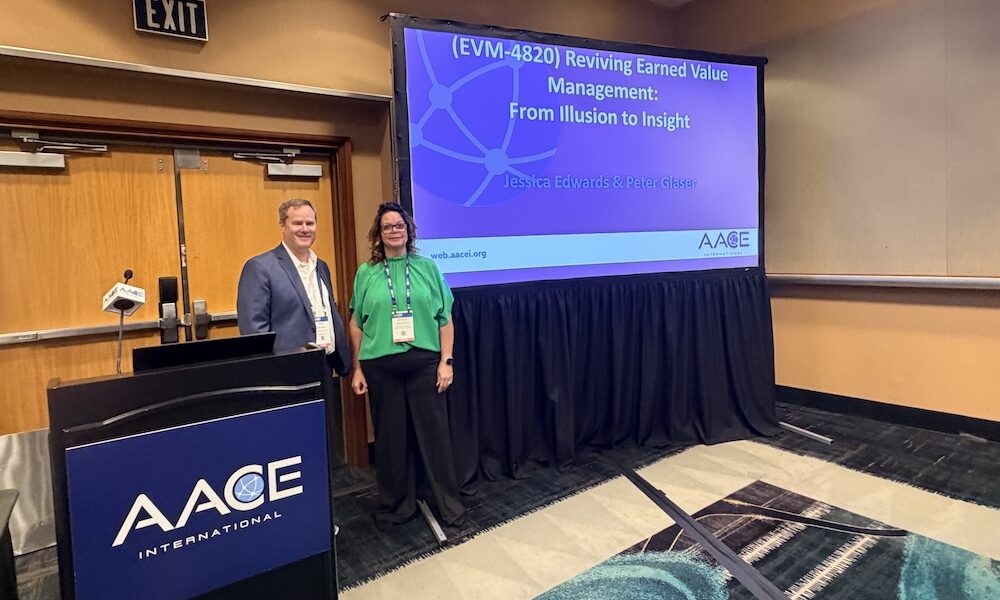
Jessica Edwards, Brindley Engineering Project Services Specialist and Peter Glaser, Brindley Engineering Project Manager, recently attended and spoke at the conference. Their title talk was: “Reviving Earned Value Management: From Illusion to Insight.” The goal was for people to leave with the understanding that EVM should be more than a compliance exercise. It should provide clarity, support decision making, and help project teams act before problems become outcomes. Having a combination of perspectives from both Project Services and Project Management was a deliberate decision to facilitate discussion on how EVM outputs land (or don’t) with the people actually running the project day to day. They hoped their talk would encourage project professionals to move from reporting performance to truly understanding performance. We sat down with the engineers to hear how the conference went.
Q: How was your presentation on Earned Value Management (EVM)?
A: It went really well. The presentation was based on my paper, Reviving Earned Value Management: From Illusion to Insight, and the goal was to close the gap between projects that technically “have” EVM in place and projects where EVM data drives real decisions. I brought Peter in to present alongside me since he could speak to the Project Management side of things and how EVM outputs land (or don’t) with the people actually running the project day to day. That combination seemed to resonate with the room; the Q&A afterward was active, especially around the processes of individual organizations, which told me the topic hit a nerve people are actively thinking about. Overall, it was a strong experience, the reviewers liked the paper as-is going in, the presentation flowed well with two perspectives instead of one, and the audience engagement afterward made it clear the topic mattered to people beyond just Peter and myself.
Q: What was your top takeaway from the talk?
A: The biggest takeaway was really about the full arc of the process, not just the moment on stage. Writing the paper taught me how to turn years of hands-on experience into something structured and defensible. The review cycle was validating, the reviewers liked the paper as it was and would have published it without changes, aside from a few wording tweaks and clarifications to make it land better with the audience. Building the presentation itself was its own lesson in distilling a dense technical paper into something a live audience could follow. And bringing Peter in as the PM voice reminded me that EVM data only matters if it translates into decisions someone can act on, pairing the project controls lens with the PM lens made the session much stronger than either perspective alone. Then, fielding questions afterward closed the loop, it showed me where the ideas landed and where I still need to sharpen my explanation. Altogether, it reinforced that presenting isn’t only about delivering information, it’s a full-cycle exercise in clarifying your own thinking.
“Bringing Peter in as the PM voice reminded me that EVM data only matters if it translates into decisions someone can act on, pairing the project controls lens with the PM lens made the session much stronger than either perspective alone.”
Q: What kind of questions were asked?
A: Attendees asked thoughtful questions about applying Schedule Performance Analysis, adjusting the weighting of control accounts, and determining which areas required greater emphasis within EVM processes. The discussion also explored how organizations might refine their rules of credit, establish more consistent structures, and improve review habits related to durations, triggers, and interpretation. Some questions focused on variance analysis, root cause analysis, and lessons learned, including how to shift the culture around variance reviews so they are viewed not as negative conversations, but as opportunities to understand project trends, support better decision-making, and help teams avoid repeating challenges encountered on previous projects.
Q: Can readers see a video of your lecture or read the published paper?
A: Yes, but for anyone who has not attended the conference, there is a charge. You can find it here: (EVM-4820) Reviving Earned Value Management: From Illusion to Insight | AACE
Q: Did you attend other lectures? Which ones and what did you learn?
A: Yes several! The one session that I enjoyed most was ‘The Ten Biggest Lies in Project Controls Told by PMs’. (Sorry Peter) This was presented by Christopher Carson and Glen Palmer. The well-known industry authors discussed the ten biggest lies that they have heard from project and construction managers. In addition to the identification of these lies, they discussed proactive actions to mitigate the problems related to the falsehoods, using lessons learned from project controls and forensic analysis/dispute resolution.
Another session I attended was the Section Leadership Meeting. I was recently named Director at Large for the AACE Chicago Midwest Section, and this was my first opportunity to participate in that forum. I was especially interested in learning about the initiatives being led by sections around the world, as well as the accomplishments and challenges they shared. The discussion provided valuable insight into the opportunities ahead for the Midwest Section and helped identify areas where we may be able to collaborate with and learn from other sections.
Q: Is there anything else you would like readers to know about this event?
A: Yes. One thing that stood out to me was how much AI came up as a theme across almost every session I attended. It wasn’t just one talk; it was a running thread through the whole conference. And within that theme, I noticed a real split in the room. A lot of people voiced apprehension, and “garbage in, garbage out” came up repeatedly as the go-to concern about AI in project controls. What I want people to know is this: garbage in and a lack of understanding of your own data will produce garbage out with or without AI, that’s not a new problem AI created, it’s one our profession has always had to manage. So, I don’t think the answer is to be afraid of AI. There will always be a place for us in project controls and project management. AI is coming whether we’re ready or not and sticking our heads in the sand and acting like it won’t touch our field is only going to hold us back. The people who lean in now, understand their data, and learn to use these tools well are the ones who are going to shape what this profession looks like next.
About Jessica Edwards:
As a Project Controls Specialist, Jessica Edwards brings a strong background in estimating, scheduling (Primavera P6), cost engineering, and digital transformation with tools like Power BI and Power Automate. She thrives on turning complexity into clarity, building processes, dashboards, and systems that empower teams to deliver with confidence.
About Peter Glaser:
As a Project Manager, Peter Glaser has a track record of leading professional development initiatives and fostering innovation in engineering. His background includes successful project management in both the Transmission and Distribution energy infrastructure industries. He excels at mentoring staff, driving process improvements, and managing maintenance and capital projects and programs.
For more about the AACE conference:
For more about Brindley Engineering:
Share this post