

Meet Brindley Engineering’s Lead Inspectors: Justin Arnold and Thomas Twardowski and our series on concrete repairs. Part 1: “Who is actually qualified to inspect concrete repairs in the field?”



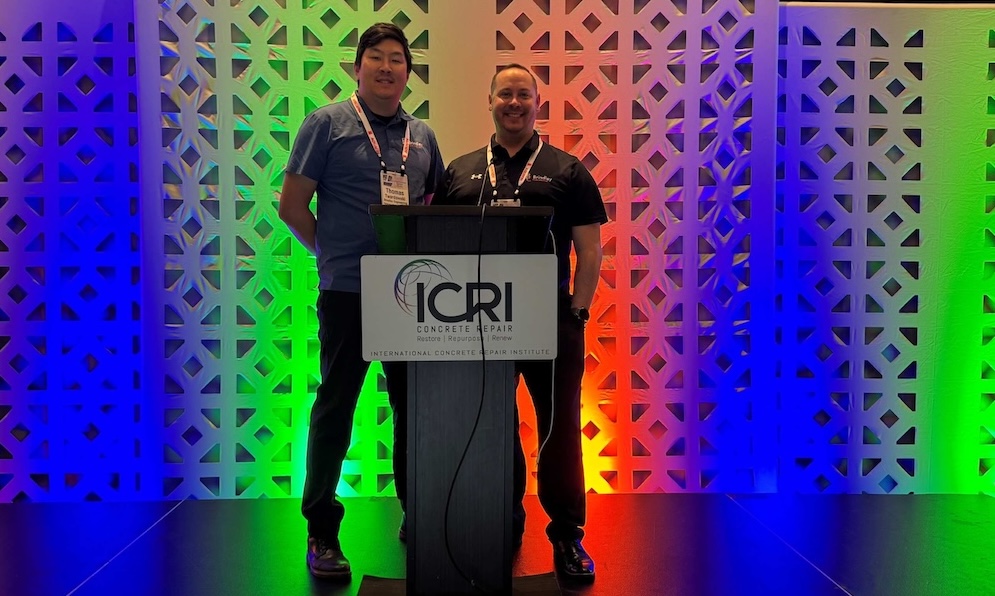
Arnold and Twardowski recently spoke at the 2026 spring ICRI convention. The Topic? Risk to Reliability: Why ICRI-Certified Repair Technicians Are Essential. The 2026 Spring Convention was dedicated to the methods and innovations that ensure our concrete structures endure. “When it goes right, nobody talks about it. When it goes wrong, everyone feels it.” says Arnold of concrete repair work.
Justin Arnold brings over 15 years of experience working across new construction, turnarounds, shutdowns, and both small and large capital projects, filling roles from field inspector, QC, QA, supervisor and project manager.
Thomas Twardowski brings over 13 years of industrial experience across petrochemical, industrial, civil, and critical facilities such as hospitals. A lot of his work has focused on field execution, seeing firsthand how concrete repair decisions play out long after the paperwork is done.
Between the two of them, they’ve seen concrete repairs succeed, and fail, at every stage of a project lifecycle. In this series we will explore 3 key themes that they talked about earlier this spring at the ICRI convention:
- Part 1: “Who is actually qualified to inspect concrete repairs in the field?”
- Part 2: “Why does it matter that ICRI CSRT is formally recognized in the commentary of ACI CODE 562-25 – Assessment, Repair, and Rehabilitation of Existing Concrete Structures?”
- Part 3: “How does this fit into the broader ACI landscape discussion?”
Welcome to Part 1: Who is actually qualified to inspect concrete repairs in the field?
As the concrete repair industry continues to evolve, owners, engineers, and contractors are increasingly asking an important question: Who is actually qualified to inspect concrete repairs in the field? The answer has significant implications for project performance, durability, safety, and risk management.
Concrete repair projects are often judged by what can be seen: the finished surface, the restored structural element, or the project’s completion date. Yet the long-term success of any repair depends on something less visible—the quality of execution in the field and the qualifications of the individuals responsible for inspecting that work.
The Challenge of Field Inspection
Concrete repair specifications often include detailed requirements for surface preparation, material placement, curing, bonding, reinforcement protection, and quality control testing. Engineers may spend months developing repair strategies and construction documents, but the success of those repairs ultimately depends on whether critical procedures are executed correctly in the field.
Historically, there has been considerable variation in how repair inspections are performed. While inspectors may possess general construction experience, many have not received specialized training focused specifically on concrete repair practices. This can create inconsistencies in evaluating repair work and increase the likelihood that critical deficiencies go unnoticed until they manifest as premature deterioration, reduced service life, or costly rework.
As repair projects become more technically demanding, the industry has recognized the need for personnel who possess demonstrated knowledge of concrete repair procedures and can consistently evaluate compliance with project requirements.
Establishing Competency Through Certification
The International Concrete Repair Institute (ICRI) developed the Concrete Surface Repair Technician (CSRT) certification program to address this need. The certification establishes a standardized benchmark for individuals involved in the inspection and execution of concrete repairs.
ICRI CSRT-certified professionals demonstrate knowledge in key areas such as:
- Concrete deterioration mechanisms
- Surface preparation requirements
- Repair material selection and placement
- Quality control procedures
- Bonding considerations
- Curing practices
- Repair inspection techniques
By establishing a consistent baseline of competency, the certification helps reduce uncertainty regarding who is qualified to evaluate repair work in the field. For owners and engineers, this provides greater confidence that repair activities are being assessed by personnel who understand the unique requirements of concrete rehabilitation projects—not just general construction practices.
Reducing Risk, Improving Reliability
At its core, concrete repair is about managing risk.Owners invest in repairs to restore performance, extend service life, improve safety, and avoid future costs. Engineers develop repair strategies to address identified deficiencies and achieve specific performance objectives. Contractors work to execute those plans efficiently and effectively.However, even the most well-designed repair can fail if critical installation requirements are not properly implemented and verified in the field.Qualified inspection personnel serve as a vital link between design intent and project execution. Their ability to identify deficiencies, verify compliance, and document quality directly impacts the reliability of the finished repair. When the question becomes, “Who is qualified to inspect concrete repairs in the field?” the industry is moving toward a clearer answer—professionals who have demonstrated repair-specific competency through recognized certification programs and who understand the unique challenges of preserving and rehabilitating our concrete infrastructure.
Get in touch today to talk more about concrete repair!
Stay tuned for Part 2 of our 3-Part series called: Why Recognition in ACI CODE 562-25 Matters
Share this post